Friday, 31 May 2013

THE TAJ MAHAL. AGRA.

The Red Fort. Snaps at The Red Fort. It's not a fluke that I snap birds in my pictures - eagles are everywhere. The driveway at The Red Fort. Audio guide this way. An archway big enough for an elephant. Stormy clouds over Agra. Another cool gate. Our first glimpse of The Taj Mahal - over the river. Weathered. Another snap. Snapped from a rikshaw. Local men and their shopping. We got up at five for sunrise, but when we opened the door the sun had already risen. A quick snap from a rooftop in Taj Ganj. And we did actually get to see the sun rise over the smog. Snapped snapping. The chai wallah and his glasses. The Masjid. Looking up. And ta-da! Frangapani trees in the garden at The Taj Mahal. Looking up. I was snap happy. This puppy was keen to see the Taj too. Snapping away. In this picture you can see me (the tiny grey spek!). A cool door. This caligraphy is cut out of the white marble, and inserted in. Another snap of the entrance to the moseleum. Snap, snap, snap. My ticket.

After a very early wake up call, a mad dash to pack the last of our things and zip our backpacks up, a rikshaw ride in the cool before the crack of dawn, and quick train trip, we arrived in Agra. It was early afternoon when we arrived, and the temperature was in the high 30's and although I'm Australian, I was feeling the heat. It's amazing how the same temperature feels incredibly different in another place. We set our air con to ice cold and chilled out. 

After an incredible home cooked meal (the advantage of staying at a home-stay) we headed out in the afternoon sun to explore The Red Fort. The Red Fort is cool - but most people visit for the view across the river. We sat, people watching and gazing across the river to at The Taj Mahal for a while, before heading into Taj Ganj (the town surrounding the site) for dinner at a rooftop restaurant. We watched the sun set behind The Taj Mahal and it all felt a little unreal.

We got up early the next morning, hoping to catch the sun rise, but unfortunately we got up just a tad late - it was already light when we opened our hotel room door. However, the dirty silver lining of India was that the sun hadn't quite made it up past the smog so we did get to see a sunrise. After a few snaps from a rooftop restaurant and a quick chai, we headed to the site, bought our tickets, and followed a big group of locals through the gates.

I've been sitting here for hours trying to write the next part of this post, but I'm struggling to put into words how I felt when I stepped through the Darwaza-i rauza and saw The Taj Mahal. It's breathtaking, and I think all I could say was 'oh wow', no picture will ever do it justice. We wandered around the gardens, snapping from every imaginable angle, doing star jumps and taking the cliche snaps. We swapped out flip flops for little feet covers - to protect the marble that surrounds the mausoleum - and took the local route (it goes around the back of the mausoleum) onto the white marble. The closer that you get to the Taj, the more surreal and incredible it is. It's enormous - my travel buddy took a picture of me (I'll post his pictures in a separate blog post soon) standing next to it and I'm a tiny speck in the picture. Once we'd had a good wander around the outside of the building we headed into the mausoleum itself, and jostled for a look at the tombs. Photographs aren't allowed inside the mausoleum - although this doesn't stop Indian tourists - so I don't have any pictures, but it's just as impressive as the outside - ornately decorated white marble, light catching the ruby red pieces set into the marble, and an eerie silence broken by the hushed whispers of guides.

We headed back into the gardens and after once last look we headed off to into Taj Ganj for a quick samosa and then to the train station to book one last train - to Delhi.

Rebecca.

Thursday, 30 May 2013

THE PINK CITY. JAIPUR.

A couple of snaps wandering around Jaipur in the morning. A gang of kids were very interested in my travel buddy. And one walked down the street with us. After almost three months in India even my soft drink tasted like masala. Chalk lines on the street in preparation for a parade. Are we in the right spot? Henna. It's about to begin. A flower arrangement on the floor. The gate to The Pink City. The biggest papad ever. A big thumbs up too Rajasthan for being the only state in India that accepts foreign student cards. A sightseeing selfie. Looking up in Janta Mantra. Another snap in Janta Mantra. A cool gate. The City Palace. Snapped from a window in the City Palace. No touching the arms - uh oh. Snapped in the courtyard at The City Palace. The ceiling. Looking up. A big pink wall. More snaps at The City Palace. A fort high up on a hill. The Amber Fort. The view from Amber Fort. Rajasthan is colourful. The secret passage under the fort. Another fort, on a hill overlooking a village. A quick snap of Albert Hall.


We arrived in Jaipur in the morning, and by the time we'd found our hotel, had a shower, and a nap, it was late afternoon so we decided to go for a wander around the city and that we'd do our sightseeing the next day. We wandered around for a while, through little alleys where a gang of kids ran towards us screaming every English word they know - hello, how are you, rupees, which country - and laughed as we chatted to them. We stopped to ask a local guy for directions, and he pointed us in the right direction, but told us that the sights were closing early as their was a festival that afternoon. He then pointed to a building across the street where there was a marque and chairs set up on the roof, and said that we could go up there and get good seats to watch the festival, for free. We were dubious at first - nothing is free in India - but went over to check it out, and as it turned out, the area was set up for tourists to watch the festival. We grabbed a couple of seats, and the street below buzzed with activity - tourists trying to cross the busy road, street vendors and their booming voices, and police trying to control the crowd of locals jostling for a good position to watch. The rooftop filled with tourists, media, and political big-wigs, and after some schmoozing, the festival started. Camels, elephants, dancing gypsies, gods, cows, marching bands - the Indian festival has it all.

The next day we were up early to do some sightseeing - Janta Mantra, Hal Mahal, The City Palace, Albert Hall, and The Amber Fort. It was a beautiful day, until we were at The Amber Fort and man took a picture of me drinking pepsi. And I snapped. I ran over, ripped his camera from his hands, deleted the picture of me, and threw it back at him. I was furious, and months of men taking pictures of me came to the surface and I couldn't ignore it. I yelled insult after insult - although he wouldn't have understood what I was saying - and he and his wife laughed. My travel buddy walked over, and I walked away. When I think back to that day, I remember feeling frustrated, angry, and upset. Frustrated because I couldn't communicated how I was feeling about the situation, angry because I couldn't do anything about it, and upset because I've never felt like this before. I felt violated, and I was helpless.

After spending the rest of the afternoon wandering around The Amber Fort, a quick bus back into the city, and a very quick lap around Albert Hall, we grabbed something to eat and headed back to our hotel to pack and get an early night as we had to be up at five the next morning to catch a train to Agra.

Rebecca.

Wednesday, 29 May 2013

THE GOLDEN CITY. JAISALMER.

A fort. Cows are everywhere in India, even in the fort. A snap from a rooftop in Jaisalmer Fort. Another snap of the view. Sitting in the big bay window looking out over Jaisalmer. The view from our guesthouse window. Looking along the fort wall. Curtains. I sat in the window and watched day turn into night and Jaisalmer light up. The lights of Jaisalmer. An oasis. Safari. Typical India. Jeepin. Ruins in the Thor desert. A castle. Looking up a the tower. Two little dolls on a bench at an abandoned ruined castle. And wooden carvings hanging on the wall. And in the afternoon we went on a camel safari. My camel was at the back and didn't want to keep up with the others. Because they put me in control of the camel, and it didn't want to listen. In the middle of the desert. Me, on a camel, in the desert. Chai at the end of a long hot afternoon. Star jumpin on the dunes. Footsteps in the sand. A selfie on the dune. Me, watching the sun set at the end of an amazing day. Sunset. Our tickets to the Jaisalmer Museum included an audio guide. Shopping. Which one? Soda.

I fell in love with Jaisalmer the minute that I arrived, and spent three beautiful days wandering around the fort, through the desert on camels, and squeezed in the little shops looking through piles and piles of wall hangings. 

We were in high spirits when our bus stopped at Jaisalmer in the morning, but I think this was a mixture of relief that we were getting off the bus, and delirium. The buses in India aren't five star, and you can expect honking, sudden swerving or breaking, and loud locals, but this bus was something else. The roads were bumpy, and it felt like the bus had no suspension, the window wouldn't stay shut which meant we were freezing cold, with no blankets, the driver honked all night, and literally all night, and had his radio on at full volume overnight, and he was driving like a bat out of hell. For the next ten hours I drifted in and out of delirious sleep, and by six the next morning my travel buddy and I were laughing at every honk and bump, and wiggled in the bed to the sound of Hindi music.

We'd booked our accommodation in Jaisalmer and it was a luxury to be able to know where we were going and that there was a room waiting for us when we got there. And it was an incredible room. It was a big room on the wall of the fort, with an incredible bay window with an amazing view over Jaisalmer, and cushions, where I sat and watched Jaisalmer go from day to dusk to night. The curtains were thin red cotton and in the afternoon the light caught them and this beautiful dusky red glow filled the room. It was the most amazing place I've ever stayed. I honestly could have sat in the bay window for days and watched the town below.

Once we'd settled in we went for a walk around town and did a bit of normal backpacking things - booked a bus, went to the bank, did laundry. We drank mango juice and watched the sun go down. 

The next day we had a bit of a lazy morning, deserved after spending five of the past seven days sleeping on buses and trains. After lunch we met up with a local guy who took us on a quick tour of a ruined castle and an oasis, before taking us to the meeting point for our camel safari. I was really nervous because I'd never ridden a camel before and was worried about getting on and off because, you know, it's meant to be difficult. It's really not, so I'm not sure why people say that it is. We - the guide, three Brits, five camels, my travel buddy, and I - set off into the desert. After a couple of hours plodding along we arrived at the dunes and while our guides started making dinner we went for a walk. The dunes were incredible, They were totally untouched and there was nothing around for miles. For once, we were the only people around. We snapped away for a little while, before sitting down and watching the sunset over the dunes. Once the sun had set we had dinner - sitting on the ground on a sheet in the middle of the desert - before jumping back in the jeep and making our way back to the fort, driver and friend in the front chatting in Hindi, and my travel buddy and I being thrown around in the back like two coconuts. 

We spent our last day in Jaisalmer wandering around the fort and shopping for wall hangings, stopping at the soda shop for blueberry and pineapple soda - I really liked it and it was only R25 for a huge cup! We made our way back to the guesthouse in the afternoon and the incredibly kind owner let us take a nap in the room before we made our way to the bus station for our last overnight bus to Jaipur. If you're ever in Jaisalmer (and I'd highly recommend you do go!) you have to get in touch with Lala, who runs The Mud Mirror guesthouse and see if he has a room. It cost us R1800 (AUD34) for two nights, and although it is a little bit a splurge, it's worth every rupee. The owner and his son are extremely hospitable, the chef cooks incredible food, and the rooms are amazing. And it's a fort!


Rebecca.

Tuesday, 28 May 2013

THE BLUE LOTUS FLOWER. PUSHKAR.

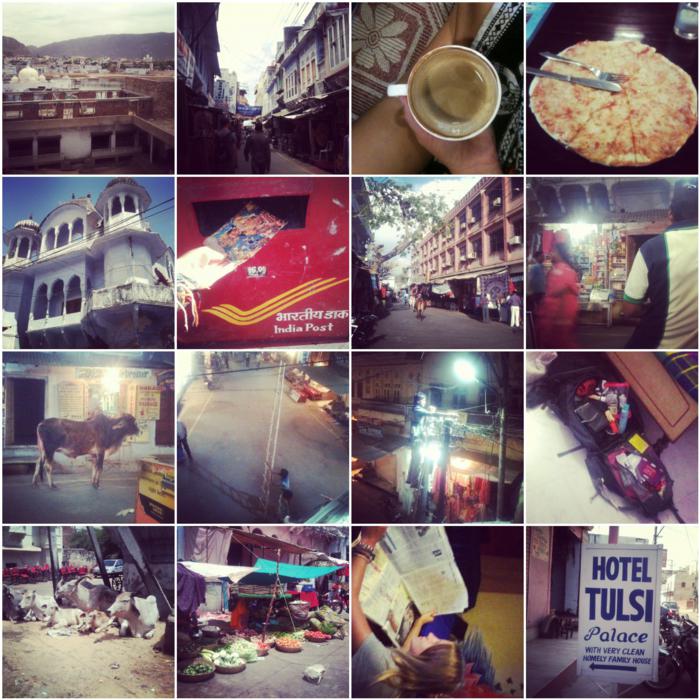
The view of Pushkar and beyond. The little streets in Pushkar. A good coffee at The Blue Sky Cafe. And a pizza, because it's what I felt like eating. I'm not sure what this building was but I called it Monkey Palace. Sending postcards. Another snap of the street. Sitting in an internet cafe watching the world go by on the street outside. And then this guy walks past. A guy walks out into the road with a ladder. And starts wiring a string of lights. Oh the life of a backpacker - packing again. Chillin. The market in Pushkar. Reading the paper. We stayed here and it was literally a family's house with a spare few rooms. 

We'd spent the best part of two days traveling, sleeping first on a bus and the next night on a train, and by the time we hopped off the train in Ajmer we were two weary travelers. We went from the train station to the bus station and just managed to squeeze ourselves on the local bus to Pushkar. I plonked myself down on the floor and cried. I was exhausted. I was tired. I was ready to go home. It was only a quick bus ride to Pushkar, and once we once again set off in search of a place to stay. A tout handed us a card as we were walking down the street and quite happily we wandered down the street to check out the guesthouse. One of the most challenging things about backpacking (to me) is finding a place to stay when you arrive in a new destination. You're fighting exhaustion and hunger, it's usually very early in the morning, your clothes are dirty, and your backpack starts to feel like it's full of bricks. Towards the end of the trip it became easier to navigate new places, chat to touts and find a place to stay without having a meltdown.

We had a wander around Pushkar that afternoon, stopping to browse the market stalls and look for postcards. We didn't actually go into the temple because we couldn't be bothered (and didn't really trust leaving our belongings with a local guy on the street) with it and because we'd heard lots of things about scams. For the same reason we avoided the ghats and the lake and stuck to wandering through the markets and eating our way through every potato dish (my comfort food!) in Pushkar. 

We only had around ten days left of our trip left at this stage and we really wanted to make the most of it so decided we'd give up the luxury of a bed and hop straight onto an overnight bus to Jaisalmer. We didn't know it at the time, but we'd booked a private bus and private buses are the worst buses in Rajasthan. We were in for a very bumpy, loud, and restless night.

Rebecca.

Monday, 27 May 2013

THE EPITOME OF INDIAN ROCK-CUT ARCHITECTURE. AURANGABAD.

Ellora Caves. Cave No. 17 an incredible temple carved into the side of a cliff. A snap with people in it, for size reference. And a snap from the top of the cliff behind it - my travel buddy hiked up and snapped with my phone. This is how Indian scaffolding is constructed. And this is how high it went. Carvings in the Ellora caves. It's incredible to see them carved into the cliffs. Jeepin' it back to town. A forgein tourist ticket to the Ajanta Caves. Thems the rules at Ajanta. The roof. Mood lighting in Ajanta. One steep staircase. The Ajanta caves cliff. Wall carvings at Ajanta. Pillars. A selfie on the steps at Ajanta. Reclining Buddha. A selfie, with a couple of Indian people. Jumboking. This is a jumboking. This is my travel buddy eating a jumboking. Ice-crime.

My memories of Aurangabad are whirlwind of buses, caves, sweltering hot days, bottles of water, and jumboking. We arrived on an overnight bus from Mumbai and after quickly finding a place to stay we ate and jumped on a bus to Ellora.

The Ellora caves are 29 kilometres from Aurangabad - around 45 minutes on the local bus or half an hour via shared jeep (bargain hard and you can get a jeep for the same price as the bus!) - and represents the epitome of Indian rock-cut architecture, so wikipedia says, and I'd agree. The caves are structures - Buddhist, Hindu, and Jain temples, viharas, and mathas - excavated from the vertical face of the Charanandri hills. I don't think I could ever describe how incredible the Ellora caves are, they're one of those places that you just have to see to believe. A path connects all of the caves, and you can easily spend the best part of a day wandering along it. You may have to climb over, under, and through some scaffolding, but it's all in a day of sightseeing in India. There is also a path along the top of the hills, but my travel buddy says it's not for the fainthearted. After a long, hot day we headed back to Aurangabad in a share jeep - we were going to take the local bus, but the jeep driver offered us the trip for the same price so we jumped in. Ask the sit in the front seat - you may end up sharing it with two other people (and then a driver) but it's better than being crammed into the back seat, or boot. There were 15 people in the jeep at one point.

 We weren't too keen on venturing too far from the hotel in Aurangabad - it's not the nicest place during the day, and after dark is incredibly seedy - so popped to the corner burger store, Jumboking, for dinner. Street food stalls are alive at night in India - fluorescent lights light the streets, crowds of locals stand around chatting and drinking chai, and the sound of pakodas in oil is a constant fizzle in the background. When you find a good street food place, you go back - again and again. Jumboking was one of those places. The burgers (with potato patties) were so good, and the salad on them was fresh. I don't remember the exact price (I remember names, my travel buddy remembers numbers) but they were budget friendly. 

The next morning we were up bright an early to hop on a bus to the Ajanta Caves. These are located a little further from Aurangabad - the local bus takes around three hours - but are worth the long, hot bus ride. The Ajanta Caves are Buddhist monastic buildings, and are masterpieces of Buddhist religious art. They are incredible - elaborate stone carvings carved by local monks and amazing mural paintings line the walls, ceiling, and floor of the caves telling stories, and silence fills the Chaitya-grihas. After another long day of cave hopping we caught the bus (just stand on the side of the road opposite the entrance to the site and the bus will stop) back to Aurangabad - standing for a little while before managing to quickly nab a seat at the back of the bus when some locals got off. 

We headed back to the hotel to grab our bags (they'd let us leave them there after checking out) and after a quick shower and a cheeky tip to the concierge for letting us duck into a room to freshen up, we headed to Jumboking for burgers and fries, before heading to the bus station to wait for our overnight bus back to Mumbai. We'd be sleeping on a bus this night, and the next night on a train, and by the time we arrived in Pushkar we were very, very wearly travelers.

Rebecca.

Tuesday, 21 May 2013

THE CITY BY THE SEA. MUMBAI.

An early morning arrival. Typical morning backpacker snap. McDonalds - because after two months you would kill for something from home. Doing the tourist thang at The India Gate. A close up. The David Sassoon Library. The Mumbai skyline. Mumbai Chowpatty. The view over the harbour from our hotel room. Street food on steroids at Bademiya. A snap of Indian scaffolding. Close up. Another tourist snap - Mumbai Clocktower. Snapped. The clock tower from the park. We took the Mumbai Metro. And here I am enjoying the metro. Haji Ali Mosque. It's a shame Indian people don't understand littering and the effect it has on our planet. Haji Ali Mosque up close. A row of shanty houses along the street. Dhobi Ghat - the biggest open air laundry in the world. Rice for sale. Mumbai's mish mash of rich and poor. Mind your head. On a narrow staircase. Indian electrical wiring. One of the entrances to Dharavi. Dharavi, the biggest slum in India. One of the streets in Dhavari. Indian people often had trouble with my travel buddy's name. Standing on the edge of the platform. We jumped on the train in the afternoon rush - it was chaos. People were hanging out of the windows and doors. Luckily a local guy helped us out and stopped us from being trampled. Indian's do a mean ice cream - kulfi! Our favourite place to eat in Mumbai. At Mumbai GPO trying to find our package. The lift at Mumbai GPO - I don't think we were meant to use it but we did and no one minded. Broken thong? No problem. It cost R20 (AUD40c) to fix and was done in five minutes. Crossing the road in Colaba. At the Mhatma Ghandi museum. Windows. Chor Bazzar, also known as thieves bazzar - if you ever have anything stolen in Mumbai it will turn up here. The India Gate. Sunrise through the blinds. The Prince of Wales Museum. Corn. From this street vendor.

As soon as we arrived in Mumbai I fell in love with the city. After a good look around Colaba we found a room at The Sea Shore Hotel - a good look around and a couple of hours waiting in the hotel reception hoping that someone would check out. We were able to get a room, and although it was a little more than we'd paid for accommodation thus far - R990 (AUD18.47) - it was the best accommodation in the area, and it was still only nine bucks a night each.

We spent the rest of the day wandering around Colaba, Churchgate, and Fort - the traveller hub, and also one of the best places to be scouted to be an extra on a Bollywood. We headed for the India Gate - the monument built to commemorate the arrive of the British East India Company in India - which was impressive, and a great place to do some people watching. Mumbai's filled with old buildings reminiscent from it's time under Portuguese and British rule, and you can easily spend the afternoon wandering up and down the streets admiring the contrast between the old and new. We did! We then did what any western traveller hoping to be scouted for Bollywood does and went to McDonalds for lunch. One of the things that I like about travelling is having opportunity to see, do, and embrace, normal things in another country, culture, and society. I like to just live, and experience life in another place. It was really interesting to visit a fast food chain in India as you get to see a different side to life in India. In western countries it's typically people in lower socioeconomic classes that patron fast food restaurants. In India, it's the opposite. Fast food restaurants are full of wealthy families and rowdy teenagers hanging out with friends.

 After lunch we wandered a little further into Mumbai and started chatting to a couple of America travellers who were heading to the Hanging Gardens - a park on a hill that overlooks Mumbai - and decided to tag along. The walk along Marine Drive, where real estate prices are among the highest in India, was beautiful, and the breeze coming from the Arabian Sea was refreshing in the heat. There's a bit of a hike to the park, but once you're there the views are worth it. Any local can point you in the right direction if you get a little lost. We said goodbye to the American travellers and hopped on a bus back to Colaba. After a quick refresh at the hotel we headed out to Bademiya - labelled street food on steroids by Lonely Planet. They weren't kidding! It was incredible. If you're ever in Mumbai you have to try it. If it wasn't expensive (for India) we'd have eaten there more often.

The next day, after a danish and frap at Starbucks, having not being scouted to be a Bollywood extra yet, we did a bit more sightseeing. We jumped on the metro - the local railway system that transports over 6.3 million people each day - and hopped of to see Haji Ali's Mosque and the dhobi ghats, the open air laundry where Mumbai's millions of residents send their laundry. We'd noticed a cinema close to our hotel, and on the way back popped in pick up tickets for the show later than evening. After a quick stop at Bademiya, we headed to the movies to see Himatwala. I picked up a big tub of caramel popcorn for R50 (AUD93c) too - I was all smiles and dancing in my seat by the time the movie finished.

If you've read Shantaram you'll know how excited I was to have breakfast at Leopalds. The cafe features heavily in the book, and there were whispers that Shantaram (that's the name the locals have given to the author) was in Mumbai. The food at Leopalds was average and overpriced, and we sat down once or twice and ordered, only to be told that frappe's weren't possible (although to be fair this does happen at lots of restaurants in India). To be completely honest, it's worth a look - you can see the bullets and some of the damage from the 2008 Mumbai terrorist attacks - but not worth going back.

While we were in Mumbai we also did a tour of the biggest slum in India, Dhavari. We chose to do our tour through Reality Tours, but we met travellers who arranged tours with slum residents and had a great time, and travellers who went with a local and got a tour of the pubs. If you can trust a local, and feel comfortable heading into the slum with them then go for it. Otherwise there are plenty of tour operators to choose from. The slum is not an unsafe place, but it is a place where you can easily get lost so a guide is a good choice. When we arrived at the slum it was nothing like I expected. It looks nothing like what you think a slum looks like. But then, what is a slum? By definition a slum is a house that occupies land that is owned by the government. But it doesn't necessarily mean poverty. Dhavari has an annual turnover of US65 billion per year. The residents in the slum churn out plastic, tin, garments, everything you can think of, and they run shops and restaurants. You could even mistake the streets of the slums for any street in India. In fact, may of the streets did look like streets I'd walked down on my trip. The only difference between those streets and the streets in Dhavari is that the government can come and knock it down whenever they want which sucks because people have built their lives on what would otherwise be a bare patch of land between two train tracks.

 We then headed for the train station, and as we were waiting on the platform I noticed that it was a little busier than usual - we'd walked into a train station at rush hour, in India. When the train pulled into the station I knew we were going to have to do as the locals do - push. It's not as bad as it sounds once you get used to the idea and learn how to do it. Elbow are key, you can use them to stop anyone from pushing in front of you, and forget personal space - there is non of that on public transport in India. I squeezed myself into the crowd and pushed my way onto the train, but then lost sight of my travel buddy. Panicking only slightly, I stood on my tiptoes and look around. The guy standing next to me must have sensed my panic and pointed above everyones heads to the other side of the doorway and said 'he got on'. Even though they'd push you out of the way to get in front of you, the locals are actually really friendly on the train. I was the only female in the carriage, and the locals left me alot more room than they leave for each other and they moved around so that my travel buddy and I could stand together. When the train stopped at Churchgate, the last station, we went to jump off the train when a local grabbed my travel buddy's arm and yelled at us to shop and wait. We stopped and were thrown against the seats when a huge crowd of locals stampeded onto the train. I'd have been trampled if I hadn't quickly moved out of the way. I stood there in awe as this crowd engulfed the carriage and quickly filled up. We thanked the local guy and jumped off the train, still a little shocked. To give you an idea of how overcrowded the train was, the train cars are rated to carry 1700 passengers but in peak hour they carry around 4500 passengers.

 We still hadn't been scouted to be an extra in a Bollywood movie, and were a little disappointed. But on our last day a traveller staying at the hotel on the floor below ours mentioned that the hotel bell boys had told her that a scout was looking for extras - but only males. I didn't want my travel buddy to miss out - and I don't mind living vicariously thorough his pictures - so we ran upstairs to chat to the bell boy. And like that, he was in. The next morning he set of shortly after the crack of dawn, and I set off on a walk abound Mumbai. Solo. I'd spent the best part of two months in India, and was confident in my ability to navigate the streets, the traffic, and bargain as hard as I could, but what really got to me on the day I went solo in Mumbai was the staring.

It's not uncommon to be stared at - male or female - in India. At first the starting didn't bother me, you put it down to curiosity, and to be honest, I was starting back as much as I was being stared at. But when I was starting at someone, and they looked at me, I looked away because I was taught that it's rude to stare as a child and have grown up living in a society where we quickly and politely look away when someone notices us looking. This isn't the case in India. They don't look away, and often they won't look away for hours and hours. And hours. My travel buddy had a guy stare at him for three hours straight on a train - the whole time we were on the train. After a while it makes you feel a little uncomfortable, but you ignore it, because trust me, yelling at the person doesn't make it stop, it makes it worse. It's not uncommon to be asked to be in photographs. It's also not uncommon to have photographs taken of you without being asked, and they're not subtle about it. On this day in Mumbai I was sitting on a wall eating corn on the cob and a group of guys close by started laughing and I realised they were taking pictures of me. I sat for a minute, thinking about how to react, and decided that I'd confront them. I walked over and said hello, and they all sort of just stared at me. I asked the guy with the phone if I could see the pictures of me and, of course, he said there weren't any. I grabbed his phone, found the pictures of me, quickly deleted them, and then walked away. When I was with my travel buddy this still happened, but when I was alone the attention I received was insane. I spent the rest of the afternoon sitting in the stairwell with some travellers, chatting about our travels, and what the boys were doing in Bollywood.

Our long week in the city by the sea came to an end, and we jumped on an overnight bus to Aurangaba, ready to explore another destination. 


Rebecca.

Monday, 20 May 2013

TO GOA OR NOT TO GOA?

Lunch in the sun on Baga Beach. How many Indian tourists can you fit on Baga Beach? Sun-lounges on Anjuna Beach. Rough surf on Anjuna Beach. Local buses are the best way to get around. Sunset in Anjuna. Scooters lined up. Typical beach snap in Goa.

We took an overnight sleeper bus - a bus with beds instead of seats - to Panajim, the capital city of Goa, and from there took a couple of local buses to Anjuna, a small town on the Goan coast. We'd taken a couple of overnight buses, but never a sleeper bus so it was a new experience for us. It's hands down the best overnight transport options in India - it's comfortable, cheap, and is decent enough to almost call a proper nights sleep. Unless the window won't stay closed, the roads are bumpy, and the driver thinks it's a good idea (it probably is on Indian roads) to honk all night - but that's another story. Try and take a sleeper bus if you're ever in India, just remember to bring a blanket to cover yourself with. Eye masks and earplugs would be a bonus but not totally essential - you do get used to the honking.

When we arrived in Anjuna we had a good look around (my travel buddy's advice and one of the best travel tips!) before finding a room for the night. We'd arrived on the morning of Holi - the colour throwing festival - and as we were heading into the town we'd seen locals and backpackers covered in brightly coloured powder. While we had our backpacks on noone bothered us, but as soon as we stepped onto the streets without then we were immediately greeted by some local boys - they gave us big hugs, sprinkled powder in my hair and smeared neon green powder on our cheeks. I could see a little girl at the guesthouse gate looking at me with pink powder in her little hand, too shy to do anything but watch. When I walked past I stopped, and crouched down to her level, Happy Holi she said as she cheekily threw the powder at my face.

We headed through town and along the beach to the flea market, held each Wednesday in Anjuna. While we didn't buy anything - Goa is ridiculously expensive in comparison with the rest of India - we spent a couple of hours wandering around, people watching, and grumbling at how expensive it was. After a couple of hours we were hungry, tried, and multi-coloured and decided to wander back to our guesthouse to have a quick shower and then head out for dinner. The orange powder sprinkled in my hair was not permanent - contrary to what my travel buddy had me believe!
There isn't a shortage of places to eat, drink, and relax in Anjuna - the streets and beach are packed with restaurants - all touting cool music, free wi-fi, and cheap drinks. I was a little disappointed by the food to be honest - it was all a bit bland, and typical of what you'd expect in a destination that being taken over by the tourist dollar.

Although I'd had a great day wandering around the flea market, that evening, when we'd finally found some time to sit down and relax, I found myself thinking that I was underwhelmed. I think my travel buddy had been thinking it a minute after we arrived. The great thing about backpacking and having no plans is that you can pack up your stuff, jump on a train and go. And we did. The next morning we booked a tatkal ticket (those tickets reserved for last minute travelers) to Mumbai. The city by the sea.

Rebecca.

Saturday, 18 May 2013

THE FORMER CAPITAL OF THE VIJAYANAGARA EMPIRE. HAMPI.

At the police station in Hampi. The amazing ruins in Hampi. Looking down from the ruins. And looking across from the top of a hill to the Virupaksha Temple. A skirt and feet selfie on the steps of the ruins. Looking across the Tungabhadra River. The monolith bull. A star jump on top of the ruins in Hampi. Beautiful ruins. A frangapani tree. Looking over the bath at the reflection of ruins. Looking up at the Virupaksha Temple. Ruins. More ruins. Even more ruins. The Stone Chariot. The Elephant Stables. Temple of 1000 statues. Another snap of the Elephant Stables. The Queen's Bath. And a day of temple hopping ends at sunset point. A ruins eclipse. We watched the sun go down on top of some boulders in the beautiful landscape of Hampi - amazing! And the moon came up behind us. A cheeky monkey. The temple elephant Lakshmi taking her morning bath. Another cheeky little guy. Lakshmi in the beautiful river.

We arrived in Hospet on an overnight train from Bangalore, and then took a rikshaw to Hampi. We were going to take the local bus, but got chatting to a rikshaw driver and decided we'd splurge on a rikshaw - it was R100 (AUD 1.83). He asked us if we had a place to stay and we said we didn't so he suggested a guesthouse and we decided to take a look. The room was nice, clean, and we managed to bargain to a really good price (R350 AUD6.41). We got settled in and had a quick look around the town - it's extremely tourist friendly and easy to get around on foot. After stopping for a quick breakfast we headed to the police station to report our arrival (all foreign visitors have to) and had a wander around the ruins that surround the town.

The landscape is incredible - a mix of dry, earthy desert with giant boulders,ruins, and lush green palms. We hiked to the top of a huge boulder, and climbed up onto one of the ruins and plonked ourselves down - and we sat for ages taking in the landscape. But you could sit there for hours and still not believe that this incredible place exists. We then wandered to the other side of town to explore the ghats before heading back to town for dinner. A couple that we met in The Andaman Islands recommended The Mango Tree, and headed off to find it. After wandering along the ghats, and through a banana plantation we bumped into a local woman who explained to us that the government shut down the restaurant because it was built on government land and the owners couldn't afford to pay the bakeesh (bribe) to keep it open. India! They'd re-located into the town so we headed back and found it. If you're going to try it (and you should because it's great food!) try to go there when it's quiet. We tended to head to restaurants that were busy (because it's less likely you'll end up with a tummy bug if they're serving freshly cooked food) but this one was just too busy. The kind of too busy that just makes you not enjoy it. After dinner we headed back to our room to relax, write postcards, and because we were told that it wasn't safe to be out too long after dark by locals.

We'd arranged with Anja (the rikshaw driver) to do a tour of Hampi, so the next morning he picked us up and we took off in his rikshaw to explore the ruins, temples and incredible landscape. It was one of my favourite days in India. He took us to every ruin in Hampi (we literally saw everything on the map!) and let us wander around until our hearts were content. We explored old temples, royal baths, and clambered over boulder after boulder stopping to pick frangapani flowers and drink fresh sugar cane juice (amazing!) with lemon (even more amazing!). At the end of the day Anja took us to sunset point, and incredible temple built on top of one of the highest boulders in Hampi. When we arrived there was a couple of travellers feeding bananas to monkeys (as suggested by their guide - thumbs up!) and they handed us a couple of bananas to give to the cheeky little monkeys. We ran out of bananas so headed inside the temple - where religious song rings out twenty four hours a day - and out over some boulders to what felt like the edge of a cliff. The guides quickly scrambled over the boulders, but it took us a little longer (I was wearing havianas too - highly impractical for boulder climbing!) but we managed eventually. And then we watched the sun go down on this incredible landscape, and the moon rise behind us. If you're ever in Hampi I'd look up Anja and ask him if he's free to zoom you around the ruins. He's a friendly, fun local who, having grown up in Hampi, knows alot about the area, knows alot of the local street kids and their tricks, and speaks a bunch of different languages - and is always happy to be taught more. He's a fair guy too - for a full day tour we paid R800 (AUD 14.64). You'll find him (or his uncle or one of his friends) at the internet cafe.

We headed back to town to our favourite restaurant - we ate at one restaurant the whole three days we were there because the food was great and the juices and smoothies were super refreshing - for a lazy dinner, before a quick cold shower and bed.

The next morning we were up early and headed down to the ghats to see the temple elephant - Lakshmi - take her morning bath. She plodded her way down the steps to the river, and spent a couple of minutes splashing around playing with stray pieces of laundry. I avoided the temple elephants as it made me angry and upset to see the elephants - standing in a cramped temple, taking money and bonking people on the head, feet in chains, all day. It was nice to know that Lakshmi got a little time in the morning to enjoy herself in the river - and she looked as if she was actually smiling.

We headed back to our room to pack up and check out. We headed to our favourite restaurant for breakfast, and spent the rest of our day lazing around, reading, and sipping on fresh juice until it was time to hop on a sleeper bus (a bus with beds instead of seats) to Goa.

Rebecca.

Friday, 17 May 2013

THE IT HUB. BANGALORE.

A rikshaw on the metre in India - I must be dreaming. The biggest pan I've ever seen. Good morning Bangalore. I love watermelon street vendors - you da bomb. A Bangalore thali. A fire, at a national monument. Tipu Sultan's Summer Palace. A snap from the top floor - where were told off and told to get down. An artsy snap of Bangalore Fort. And a snap of the gates with my travel buddy for size reference. Spice! The corriander market under an overpass. More spice! A street. Making friends. And back on the train.

We only stayed overnight in Bangalore but in 24 hours we were able to have a wander around the city and discover what Bangalore has to offer. We arrived in the morning, and were leaving the next evening on a train to Hospet so it made sense to stay close to the train station - in the seedy backpacker hub on S C Road. Once we'd settled into the hotel we made a beeline for the nearest mall and rode the elevators straight up to the cinema. Although I consider myself a bit of a movie buff, I hardly ever go to the cinema (six times in three years and on most of those occasions I had free tickets) at home because it's just too expensive. It was nice to be able to afford to go to the cinema, and buy popcorn, and we did it as often as we could. Two tickets at a local cinema - the old theatre kind - are R120 (AUD 2.25) and tickets at a multiplex are R240 (AUD 4.50). Well, they're usually around those prices. The thing in India is that prices aren't consistent between towns, cities, and states. Two tickets in Chennai cost R240, and at the same cinema in Bangalore two tickets cost R540 (AUD 10.10). Still - a movie ticket for five bucks and popcorn for R50 (AUD 98c)!

The next morning we checked out of the hotel and took our bags to the bus station cloak room. It cost us R62 (AUD 1.16) to leave both of our bags there all day. Another thumbs up for India. We then set of for a long walk around Bangalore, stopping for a moment to relax (ha!) in the Botanic Gardens and at Tipu Sultans Summer Palace. We then wandered down to the remains of Bangalore Fort and under a bypass (where the was a spice and coriander market) to the city market where we walked through a flower market, past pyramids of coloured paint - for the upcoming holi festival - and spice, and the biggest pan in the world.

Tired and weary from walking all day we headed back to the bus station to grab our bags, and then plonked ourselves down in the train station to wait for our train to Hampi.

Rebecca.

A PORTUGUESE TOWN. FORT KOCHI.

The stores along Bazaar Road are cool - the ones was potato and onion. A sign outside the spice market. Bags of spices outside the spice market. A great sign. The language barrier is more of a can't-say-it-fast-enough barrier, but you try saying this fast. Bus and ferry tickets from our journey to Fort Kochi. A good restaurant in Fort Kochi. We had to break out of our guesthouse in the morning, and climb over the fence. An early morning in Fort Kochi checking out the old Chinese fishing nets. There's a massive art scene in Fort Kochi. Waiting at the train station to book a Tatkal ticket. And now waiting for the ferry back to Mattancherry. Where we strolled around Jew Town. And stopped to watch this guy make ali baba pants. Another few snaps of the street art in Fort Kochi. I don't know why but I felt like I needed to snap a picture of this door. Santa Cruise Basilica. Another snap of the fishing nets. And For Kochi beach. Looking down the corridor of a sleeper class coach. And looking at the top bunk. Me perched up on the top bunk. Looking down at my travel buddy.

It took two buses and a ferry to get to Fort Kochi, but by this time of my trip I'd come to like the delirious, tiring, confusing traveling, because it was always followed by arriving at a new place to explore. It's pretty normal when you get off a bus, train, or ferry to be confronted with touts - one, or ten. At first I was reluctant to listen to the touts, and I put this down to the fact that I'd never been in a situation like this and didn't know how to gauge whether I could trust someone. When we jumped off the ferry in Fort Kochi there was only one tout. He said hello to me and I decided to take a chance and say hello back. After chatting to him for a couple of minutes we hopped in a rikshaw to check out his guesthouse and it turned out that it was an awesome room - and it had w-fi (always a bonus!). We got settled in and headed out to explore the town.

Fort Kochi is a small town and it's super easy to get around on foot. We spent the afternoon wandering along the shore - giggling at Indian travelers experiencing sand and waves for the first time, exploring the street art filled alleyways, and stopping to snap pictures at one of the coolest road signs. Ever. After a lazy afternoon and a quick dinner we headed back to the guesthouse to book a couple of trains and buses. We managed to get most of them booked before the credit card we were using (my travel buddies as the fees on mine were insane!) was canceled. We were planning on booking a Tatkal train ticket (a tatkal ticket is a ticket that is available for sale the day before the train departs for last minute emergency travelers) and needed the card to work the morning to get our tickets. Fortunately when we contacted the card provider call centre we spoke to a lovely lady who (surprise surprise!) was in India, and understood out situation and quickly unblocked the card for us. Another thumbs up for India! 

Each morning on the Fort Kochi shore the local fishermen use big old Chinese fishing nets to fish from the shore and it's an incredible sight. We were up at the crack of dawn but unfortunately the guesthouse owners didn't tell us that they were going to lock the doors at night and we were locked in. I opened the door to the balcony and we had a quick look and decided it was safe to climb down, and then had to jump the gates to get onto the street - so we did, all watched by a local woman from her kitchen window. Once we'd had a wander along the shore we got the ferry to the mainland and then a rikshaw to the train station to book out Tatkal tickets. It was alot easier than we thought it would be, and it's a great idea for backpackers, who often don't know when they're coming and going, as the trains get booked very quickly. As long as you can get to any train station the day before the train departs at 10am you will almost always get a ticket. Once that was out of the way we caught the ferry back to the western part of Fort Kochi - Mattancherry.

Mattancherry was the gateway to the spice trade and if you wander down Bazzar Road you'll see (you'll smell it before you see it) the remains of the once booming trade. Littered along the street are stores with bags and bags of potatoes and onions piled high. We wandered along the streets of Mattancherry, occasionally popping into a store to check out locally made clothes, postcards, and handicrafts, and had a look around the Paradesi Synagouge, before heading back to our guesthouse to freshen up (it was humid!) and wandering into town to The Mango Tree for dinner. After dinner we sat ourselves down in an internet cafe to book our last few trains. While we were in the internet cafe we started chatting to a couple of travelers who were on their way to Munnar. We told the about the local buses and gave them recommendations for where to stay and what to do and it was here that I felt like a real backpacker - I couldn't believe that I'd been backpacking in India for two whole months and survived.

We checked out of our guesthouse the next morning and spent the day wandering around the town, and chilling out in the guesthouse lounge - they had a few guidebooks so I curled up on a chair and got stunk into the Bangalore chapter.

Rebecca.